

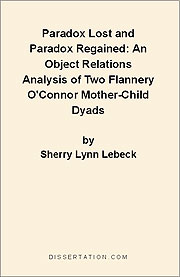
Paradox Lost and Paradox Regained
An Object Relations Analysis of Two Flannery O'Connor Mother-Child Dyads
by Sherry L. Lebeck

- Number of Pages: 190
- ISBN-10: 1581120869
- ISBN-13: 9781581120868
- Publisher: Dissertation.com
- Year: 1999
- Category: Psychology, Psychology
 View First 25 Pages:
 (free download)
 Synopsis
This study uses two short stories by Flannery O'Connor to explore D. W. Winnicott's theory of early childhood development. This thesis proposes that the "inherited potential" of the individual is determined by the quality of the early maternal environment, especially during the period of Winnicott's first two paradoxical stages of development: Absolute Dependence and Relative Dependence. The mother-adult/child relationships in O'Connor's two short stories "Good Country People" and "The Enduring Chill" serve as case studies to examine the ramifications of "not good-enough" mothering on the infant's psychological state during these first two stages of development. The concepts of mirroring, impingement, true and false self development, illusion, transitional phenomenon, and aggression are considered in the context of the mother-child relationship to demonstrate how maternal inadequacy undermines all aspects of the child's "going-on-being."In "The Enduring Chill" it was determined that protagonist Asbury Fox is psychologically fixated at the stage of Absolute Dependence because he exhibits symptoms indicative of repetitive early environmental impingement: He is maternally dependent, has little or no sense of self, exhibits primitive omnipotence and thwarted creativity. Conversely, Joy/Hulga Hopewell in "Good Country People" achieves the developmental stage of Relative Dependence based upon her ability to physically and psychologically separate from her mother, forge her own identity, accomplish educational goals, and make use of transitional objects.
In conjunction with the observation of mother-infant dyads, the impact of the absent father is further assessed to determine the level of impairment and quality of the adult-child's achievement of independence. It was concluded that Asbury Fox was unable to complete passage of the Oedipus complex, because his father died when he was five. Divorce, when Joy/Hulga is ten, leaves her without a father to mediate between mother and daughter. Thus, these two angry adult children experience either dependency, like Asbury Fox who searches for fathers in life, or rejection of maternal closeness like Joy/Hulga who attempts to forge a father in the creation of a name.
Paperback
$19.95
Order from Universal Publishers
190 Pages (sold non-returnable)
Order from 

Order from 
Order from Harvard.com
Book Store
eBook formats
First 25 PDF pages: Free
 Download first 25 pages
 Size: PDF 120k
Entire PDF eBook: $17
Size: PDF 455k
 &
&



 View or Post a Review at Amazon.com
